| Ver tema anterior :: Ver tema siguiente |
| Autor |
Mensaje |
simple.joy 

Registrado: 30 Mayo 2022
Mensajes: 954
|
 Publicado: Dom Ene 12, 2025 12:39 am Asunto: |
|
Publicado: Dom Ene 12, 2025 12:39 am Asunto: |
|
|
simple.joy wrote:
Here are some shots with my trusty Agfa D-Lab Zoom lens:


_________________
---
Manual lens enthusiast
https://www.flickr.com/photos/simple_joy/ |
|
| Volver arriba |
|
 |
kds315*


Registrado: 12 Mar 2008
Mensajes: 16912
Ubicación: Kehl, Germany
Expire: 2021-03-09
|
Publicado: Dom Ene 12, 2025 10:12 am Asunto: |
|
Publicado: Dom Ene 12, 2025 10:12 am Asunto: |
|
|
kds315* wrote:

That is one fine Printer Lens!!!
_________________
Klaus - Admin
"S'il vient a point, me souviendra" [Thomas Bohier (1460-1523)]
http://www.macrolenses.de for macro and special lens info
http://www.pbase.com/kds315/uv_photos for UV Images and lens/filter info
https://www.flickr.com/photos/kds315/albums my albums using various lenses
http://photographyoftheinvisibleworld.blogspot.com/ my UV BLOG
http://www.travelmeetsfood.com/blog Food + Travel BLOG
https://galeriafotografia.com Architecture + Drone photography
Currently most FAV lens(es):
X80QF f3.2/80mm
Hypergon f11/26mm
ELCAN UV f5.6/52mm
Zeiss UV-Planar f4/60mm
Zeiss UV-Planar f2/62mm
Lomo Уфар-12 f2.5/41mm
Lomo Зуфар-2 f4.0/350mm
Lomo ZIKAR-1A f1.2/100mm
Nikon UV Nikkor f4.5/105mm
Zeiss UV-Sonnar f4.3/105mm
CERCO UV-VIS-NIR f1.8/45mm
CERCO UV-VIS-NIR f4.1/94mm
CERCO UV-VIS-NIR f2.8/100mm
Steinheil Quarzobjektiv f1.8/50mm
Pentax Quartz Takumar f3.5/85mm
Carl Zeiss Jena UV-Objektiv f4/60mm
NYE OPTICAL Lyman-Alpha II f1.1/90mm
NYE OPTICAL Lyman-Alpha I f2.8/200mm
COASTAL OPTICS f4/60mm UV-VIS-IR Apo
COASTAL OPTICS f4.5/105mm UV-Micro-Apo
Pentax Ultra-Achromatic Takumar f4.5/85mm
Pentax Ultra-Achromatic Takumar f5.6/300mm
Rodenstock UV-Rodagon f5.6/60mm + 105mm + 150mm
|
|
| Volver arriba |
|
|
e6filmuser
Registrado: 12 Nov 2010
Mensajes: 1159
Ubicación: Reading UK
|
Publicado: Mié Ene 15, 2025 11:57 am Asunto: |
|
Publicado: Mié Ene 15, 2025 11:57 am Asunto: |
|
|
e6filmuser wrote:
Oak Spangle Gall. EM-1, probably Kiron 105mm, flash. Gall size probably about 5mm.

_________________
Dedicated to using manual focus lenses with digital. Equiped for photography from macro to panoramic & from ultra-wide to extreme telephoto. Mostly shooting outdoor macro. Experienced entomological taxonomist. Some knowledge of mushrooms. |
|
| Volver arriba |
|
|
e6filmuser
Registrado: 12 Nov 2010
Mensajes: 1159
Ubicación: Reading UK
|
Publicado: Mié Ene 15, 2025 2:24 pm Asunto: |
|
Publicado: Mié Ene 15, 2025 2:24 pm Asunto: |
|
|
e6filmuser wrote:
Opilione (harvestman). EM-1,Leitz Photar 50mm at f11 on 170mm extension, FOV 4mm wide. Flash. From 2019.

Another Opilione through a Photar 25mm here:
https://forum.mflenses.com/harvestman-eyes-through-leitz-wetzlar-photar-25mm-t80353,highlight,%2Bphotar.html
_________________
Dedicated to using manual focus lenses with digital. Equiped for photography from macro to panoramic & from ultra-wide to extreme telephoto. Mostly shooting outdoor macro. Experienced entomological taxonomist. Some knowledge of mushrooms.
Editado por última vez por e6filmuser el Mié Ene 15, 2025 4:47 pm; editado 1 vez en total |
|
| Volver arriba |
|
|
e6filmuser
Registrado: 12 Nov 2010
Mensajes: 1159
Ubicación: Reading UK
|
Publicado: Mié Ene 15, 2025 2:44 pm Asunto: |
|
Publicado: Mié Ene 15, 2025 2:44 pm Asunto: |
|
|
e6filmuser wrote:
Opilio saxatilis Female. EM-1, 1:2 x Oshiro 60mm macro. Sunlight. September 2017.

_________________
Dedicated to using manual focus lenses with digital. Equiped for photography from macro to panoramic & from ultra-wide to extreme telephoto. Mostly shooting outdoor macro. Experienced entomological taxonomist. Some knowledge of mushrooms. |
|
| Volver arriba |
|
|
e6filmuser
Registrado: 12 Nov 2010
Mensajes: 1159
Ubicación: Reading UK
|
Publicado: Lun Ene 20, 2025 9:09 pm Asunto: |
|
Publicado: Lun Ene 20, 2025 9:09 pm Asunto: |
|
|
e6filmuser wrote:
A Symphylan, a relative of centipedes, smaller and difficult to find and then active. This was almost successful but one antenna moved slightly.
Olympus EM-1, Leitz Photar 50mm at f11, flash, hand held.
]
_________________
Dedicated to using manual focus lenses with digital. Equiped for photography from macro to panoramic & from ultra-wide to extreme telephoto. Mostly shooting outdoor macro. Experienced entomological taxonomist. Some knowledge of mushrooms. |
|
| Volver arriba |
|
|
e6filmuser
Registrado: 12 Nov 2010
Mensajes: 1159
Ubicación: Reading UK
|
Publicado: Jue Ene 30, 2025 9:56 am Asunto: |
|
Publicado: Jue Ene 30, 2025 9:56 am Asunto: |
|
|
e6filmuser wrote:
One from 2015. A midge.
Olympus EM-1, reversed HM40 f16, uncropped. FOV 6mm wide. Hand held. Twin TTL flash.

_________________
Dedicated to using manual focus lenses with digital. Equiped for photography from macro to panoramic & from ultra-wide to extreme telephoto. Mostly shooting outdoor macro. Experienced entomological taxonomist. Some knowledge of mushrooms. |
|
| Volver arriba |
|
|
visualopsins
Registrado: 05 Mar 2009
Mensajes: 11704
Ubicación: California
Expire: 2027-07-11
|
Publicado: Jue Ene 30, 2025 8:27 pm Asunto: |
|
Publicado: Jue Ene 30, 2025 8:27 pm Asunto: |
|
|
visualopsins wrote:
And you guys have moved from "Awesome Photography" into "Unprecedented Quality Photography".
_________________
☮☮☮☮☮☮☮☮☮☮☮☮☮☮☮☮☮☮☮☮☮☮☮☮☮☮☮☮☮☮☮☮ like attracts like! ☮☮☮☮☮☮☮☮☮☮☮☮☮☮☮☮☮☮☮☮☮☮☮☮☮☮☮☮☮☮☮☮
Cameras: Sony ILCE-7RM2, Spotmatics II, F, and ESII, Nikon P4
Lenses:
M42 Asahi Optical Co., Takumar 1:4 f=35mm, 1:2 f=58mm (Sonnar), 1:2.4 f=58mm (Heliar), 1:2.2 f=55mm (Gaussian), 1:2.8 f=105mm (Model I), 1:2.8/105 (Model II), 1:5.6/200, Tele-Takumar 1:5.6/200, 1:6.3/300, Macro-Takumar 1:4/50, Auto-Takumar 1:2.3 f=35, 1:1.8 f=55mm, 1:2.2 f=55mm, Super-TAKUMAR 1:3.5/28 (fat), 1:2/35 (Fat), 1:1.4/50 (8-element), Super-Multi-Coated Fisheye-TAKUMAR 1:4/17, Super-Multi-Coated TAKUMAR 1:4.5/20, 1:3.5/24, 1:3.5/28, 1:2/35, 1:3.5/35, 1:1.8/85, 1:1.9/85 1:2.8/105, 1:3.5/135, 1:2.5/135 (II), 1:4/150, 1:4/200, 1:4/300, 1:4.5/500, Super-Multi-Coated Macro-TAKUMAR 1:4/50, 1:4/100, Super-Multi-Coated Bellows-TAKUMAR 1:4/100, SMC TAKUMAR 1:1.4/50, 1:1.8/55
M42 Carl Zeiss Jena Flektogon 2.4/35
Contax Carl Zeiss Vario-Sonnar T* 28-70mm F3.5-4.5
Pentax K-mount SMC PENTAX-A ZOOM 1:3.5 35~105mm, SMC PENTAX ZOOM 1:4 45~125mm
Nikon Micro-NIKKOR-P-C Auto 1:3.5 f=55mm, NIKKOR-P Auto 105mm f/2.5 Pre-AI (Sonnar), Micro-NIKKOR 105mm 1:4 AI, NIKKOR AI-S 35-135mm f/3,5-4,5
Solinon 1:5.6/18 ASPH.
Tamron SP 17mm f/3.5 (51B), Tamron SP 17mm f/3.5 (151B), SP 500mm f/8 (55BB), SP 70-210mm f/3.5 (19AH)
Vivitar 100mm 1:2.8 MC 1:1 Macro Telephoto (Kiron)
|
|
| Volver arriba |
|
|
e6filmuser
Registrado: 12 Nov 2010
Mensajes: 1159
Ubicación: Reading UK
|
Publicado: Lun Feb 03, 2025 11:57 am Asunto: |
|
Publicado: Lun Feb 03, 2025 11:57 am Asunto: |
|
|
e6filmuser wrote:
Winter Jasmine
First stereo with Focotar-2 50mm f4.5 (not reversed), on Olympus EM-1, Vm4/3, 57mm M39 extension, F11, FOV ca17mm wide, twin flash. Hand held.

_________________
Dedicated to using manual focus lenses with digital. Equiped for photography from macro to panoramic & from ultra-wide to extreme telephoto. Mostly shooting outdoor macro. Experienced entomological taxonomist. Some knowledge of mushrooms. |
|
| Volver arriba |
|
|
simple.joy
Registrado: 30 Mayo 2022
Mensajes: 954
|
Publicado: Lun Feb 03, 2025 1:48 pm Asunto: |
|
Publicado: Lun Feb 03, 2025 1:48 pm Asunto: |
|
|
simple.joy wrote:
| e6filmuser escribió: |
Winter Jasmine
First stereo with Focotar-2 50mm f4.5 (not reversed), on Olympus EM-1, Vm4/3, 57mm M39 extension, F11, FOV ca17mm wide, twin flash. Hand held.
|
Very nice - great detail! I really like the Focotar-2 even though it's kinda slow of course.
_________________
---
Manual lens enthusiast
https://www.flickr.com/photos/simple_joy/ |
|
| Volver arriba |
|
|
simple.joy
Registrado: 30 Mayo 2022
Mensajes: 954
|
Publicado: Lun Feb 03, 2025 1:52 pm Asunto: |
|
Publicado: Lun Feb 03, 2025 1:52 pm Asunto: |
|
|
simple.joy wrote:
Here are a couple of shots with my (damaged) ROW Visionar 119 mm f/1.9:


_________________
---
Manual lens enthusiast
https://www.flickr.com/photos/simple_joy/ |
|
| Volver arriba |
|
|
e6filmuser
Registrado: 12 Nov 2010
Mensajes: 1159
Ubicación: Reading UK
|
Publicado: Mar Feb 04, 2025 7:38 am Asunto: |
|
Publicado: Mar Feb 04, 2025 7:38 am Asunto: |
|
|
e6filmuser wrote:
Verbena. Focotar-2 50mm. Same setup and FOV as for the Jasmine, f11. I have pulled back the highlights a bit.

A single flower with more interesting detail:
https://forum.mflenses.com/the-vmft-system-sample-shots-t64515.html#1590247
_________________
Dedicated to using manual focus lenses with digital. Equiped for photography from macro to panoramic & from ultra-wide to extreme telephoto. Mostly shooting outdoor macro. Experienced entomological taxonomist. Some knowledge of mushrooms. |
|
| Volver arriba |
|
|
e6filmuser
Registrado: 12 Nov 2010
Mensajes: 1159
Ubicación: Reading UK
|
Publicado: Jue Feb 13, 2025 11:14 am Asunto: |
|
Publicado: Jue Feb 13, 2025 11:14 am Asunto: |
|
|
e6filmuser wrote:
Here is one from 2013:
Cleistocactus in flower.
Olympus EP-2, Tamron SP 90mm macro, f11 ISO 200, natural light, hand-held.
These are upsized copies from another host site.
With auto alignment in Stereo Photo Maker

Without auto alignment in Stereo Photo Maker

_________________
Dedicated to using manual focus lenses with digital. Equiped for photography from macro to panoramic & from ultra-wide to extreme telephoto. Mostly shooting outdoor macro. Experienced entomological taxonomist. Some knowledge of mushrooms. |
|
| Volver arriba |
|
|
simple.joy
Registrado: 30 Mayo 2022
Mensajes: 954
|
Publicado: Jue Feb 13, 2025 2:45 pm Asunto: |
|
Publicado: Jue Feb 13, 2025 2:45 pm Asunto: |
|
|
simple.joy wrote:
| e6filmuser escribió: |
Here is one from 2013:
Without auto alignment in Stereo Photo Maker
|
Works great - is significanlty more impactful to my eyes than the other version!
_________________
---
Manual lens enthusiast
https://www.flickr.com/photos/simple_joy/ |
|
| Volver arriba |
|
|
simple.joy
Registrado: 30 Mayo 2022
Mensajes: 954
|
|
| Volver arriba |
|
|
e6filmuser
Registrado: 12 Nov 2010
Mensajes: 1159
Ubicación: Reading UK
|
Publicado: Jue Feb 13, 2025 3:09 pm Asunto: |
|
Publicado: Jue Feb 13, 2025 3:09 pm Asunto: |
|
|
e6filmuser wrote:
| simple.joy escribió: |
All shot with a Meopta Meostigmat 84 mm f/1.7:
 |
A good set. I would have cropped off a chunk of the highlights on the right side. Making that frame that bit narrower than the other one would not affect viewing while reducing the distraction.
_________________
Dedicated to using manual focus lenses with digital. Equiped for photography from macro to panoramic & from ultra-wide to extreme telephoto. Mostly shooting outdoor macro. Experienced entomological taxonomist. Some knowledge of mushrooms. |
|
| Volver arriba |
|
|
e6filmuser
Registrado: 12 Nov 2010
Mensajes: 1159
Ubicación: Reading UK
|
Publicado: Vie Feb 14, 2025 3:28 pm Asunto: |
|
Publicado: Vie Feb 14, 2025 3:28 pm Asunto: |
|
|
e6filmuser wrote:
This is via a 4/3 lens adapted to 4/3. I have lots of stereos, always with the same lens, or with the Laowa 25mm x2.5 to x5, so maybe of limited interest here?
Expanded spore capsules of Hemitrichia sp, from November 2017.
This slime mould is ready to release its spores from this network.
Olympus EM-1, 4/3 50mm f2 macro at f16, twin flash, hand held.

_________________
Dedicated to using manual focus lenses with digital. Equiped for photography from macro to panoramic & from ultra-wide to extreme telephoto. Mostly shooting outdoor macro. Experienced entomological taxonomist. Some knowledge of mushrooms. |
|
| Volver arriba |
|
|
e6filmuser
Registrado: 12 Nov 2010
Mensajes: 1159
Ubicación: Reading UK
|
Publicado: Vie Feb 14, 2025 3:41 pm Asunto: |
|
Publicado: Vie Feb 14, 2025 3:41 pm Asunto: |
|
|
e6filmuser wrote:
Lycoperdon perlatum, a common puffball fungus. October 2024
Hardware data as previous but f8.

Plus a resupinate (upside down) or crust fungus, "toothed" species, from the same location. Maybe the size of the palm of my hand. It was growing under an overhang on the end of a huge log and adjacent to stinging nettles.
f11.

_________________
Dedicated to using manual focus lenses with digital. Equiped for photography from macro to panoramic & from ultra-wide to extreme telephoto. Mostly shooting outdoor macro. Experienced entomological taxonomist. Some knowledge of mushrooms. |
|
| Volver arriba |
|
|
e6filmuser
Registrado: 12 Nov 2010
Mensajes: 1159
Ubicación: Reading UK
|
Publicado: Vie Feb 14, 2025 4:13 pm Asunto: |
|
Publicado: Vie Feb 14, 2025 4:13 pm Asunto: |
|
|
e6filmuser wrote:
Alder Leaf Beetle Agelastica alni, mating.
Olympus EM-1, (aperture priority), x2TC, Olympus 4/3 50mm f2 macro, f11.

_________________
Dedicated to using manual focus lenses with digital. Equiped for photography from macro to panoramic & from ultra-wide to extreme telephoto. Mostly shooting outdoor macro. Experienced entomological taxonomist. Some knowledge of mushrooms. |
|
| Volver arriba |
|
|
e6filmuser
Registrado: 12 Nov 2010
Mensajes: 1159
Ubicación: Reading UK
|
Publicado: Mar Feb 18, 2025 9:37 am Asunto: |
|
Publicado: Mar Feb 18, 2025 9:37 am Asunto: |
|
|
e6filmuser wrote:
Cyclamen.
My very first images through my Rayfact 90mm f4. This is the Nikon F mount version, less weatherproof than the others.
Sony A7r3, Nikon Rayfact 90mm at f11, backlit via "obscure" glass domestic window, ISO 800, hand held.
I hadn't realised that the sensor had collected a lot of fine particles of dirt. I removed most of the dark dots digitally.
Normal processing, except that the second image has had the shadows filled digitally.


_________________
Dedicated to using manual focus lenses with digital. Equiped for photography from macro to panoramic & from ultra-wide to extreme telephoto. Mostly shooting outdoor macro. Experienced entomological taxonomist. Some knowledge of mushrooms. |
|
| Volver arriba |
|
|
e6filmuser
Registrado: 12 Nov 2010
Mensajes: 1159
Ubicación: Reading UK
|
Publicado: Mié Feb 19, 2025 4:35 pm Asunto: |
|
Publicado: Mié Feb 19, 2025 4:35 pm Asunto: |
|
|
e6filmuser wrote:
Snowdrop (I couldn't find an unmarked or undamaged flower).
EM- 1, 48mm extension, Focotar-2 50mm, f11 FOV 30mm. ISO 1000 or 2000, -1EV. Hand held.


_________________
Dedicated to using manual focus lenses with digital. Equiped for photography from macro to panoramic & from ultra-wide to extreme telephoto. Mostly shooting outdoor macro. Experienced entomological taxonomist. Some knowledge of mushrooms. |
|
| Volver arriba |
|
|
e6filmuser
Registrado: 12 Nov 2010
Mensajes: 1159
Ubicación: Reading UK
|
Publicado: Jue Feb 20, 2025 12:12 pm Asunto: |
|
Publicado: Jue Feb 20, 2025 12:12 pm Asunto: |
|
|
e6filmuser wrote:
Miniature Daffodil (thumbnail size) 20 Feb 2025
Sony A7r3, 132mm extension (Olympus OM telescopic tubes) from adapter. Olympus OM-System Zuiko Auto-Macro 135mm 4.5 at f11, Twin flash. Hand held.
My first try with this lens and I am very pleased. The image still has traces of sensor dust but that can be worked on.

_________________
Dedicated to using manual focus lenses with digital. Equiped for photography from macro to panoramic & from ultra-wide to extreme telephoto. Mostly shooting outdoor macro. Experienced entomological taxonomist. Some knowledge of mushrooms. |
|
| Volver arriba |
|
|
e6filmuser
Registrado: 12 Nov 2010
Mensajes: 1159
Ubicación: Reading UK
|
Publicado: Jue Feb 20, 2025 2:50 pm Asunto: |
|
Publicado: Jue Feb 20, 2025 2:50 pm Asunto: |
|
|
e6filmuser wrote:
| e6filmuser escribió: |
Miniature Daffodil (thumbnail size) 20 Feb 2025
Sony A7r3, 132mm extension (Olympus OM telescopic tubes) from adapter. Olympus OM-System Zuiko Auto-Macro 135mm 4.5 at f11, Twin flash. Hand held.
My first try with this lens and I am very pleased. The image still has traces of sensor dust but that can be worked on.
|
This is exactly how the setup looked, apart from the plastic support, for shooting this image only.

_________________
Dedicated to using manual focus lenses with digital. Equiped for photography from macro to panoramic & from ultra-wide to extreme telephoto. Mostly shooting outdoor macro. Experienced entomological taxonomist. Some knowledge of mushrooms. |
|
| Volver arriba |
|
|
visualopsins
Registrado: 05 Mar 2009
Mensajes: 11704
Ubicación: California
Expire: 2027-07-11
|
Publicado: Lun Feb 24, 2025 11:11 pm Asunto: |
|
Publicado: Lun Feb 24, 2025 11:11 pm Asunto: |
|
|
visualopsins wrote:
From a fascinating lens: https://www.spaceweather.com/archive.php?view=1&day=24&month=02&year=2025
| Cita: |
GRAVITATIONAL LENS STEREOSCOPY: In recent years, some astronomers have wondered if images of gravitationally lensed galaxies could be combined as stereo pairs, allowing a 3D view of star systems billions of light years away. The technique is called "gravitational lens stereoscopy." German stereoscopist Hanno Falk just tried it with JWST images of the famous question mark galaxy in Eridanus, and here is the result:
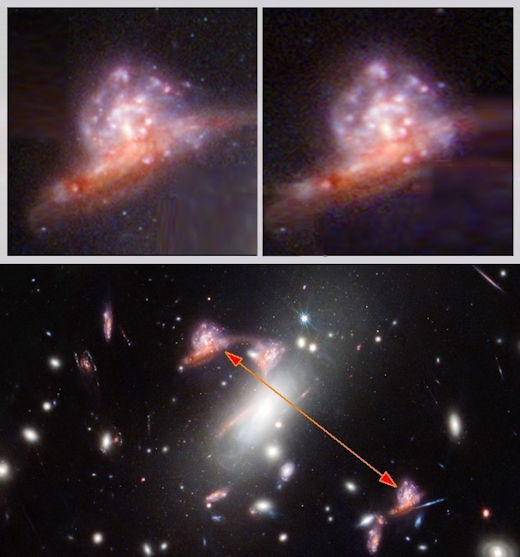
"I combined two lensed images of the same galaxy to create a pair of 3D-cross-eyed pictures," explains Falk.
To make this work, click on the full-sized image. Stare at the two side-by-side frames, slowly crossing your eyes until they merge. The shape of the galaxy should pop out of the screen.
For readers whose eyes won't cross, Falk created this blink comparison that captures some of the same effect:
https://youtu.be/rYZnrySE5dQ
An anaglyph is also available if you have red-blue glasses: Take a look.
This galaxy went viral in 2023 when Hubble images captured what appeared to be a cosmic question mark. A closer look by the JWST revealed it to be a pair of interacting galaxies--one stripping plumes of gas and stars from the other. In addition, these galaxies are lensed by an intervening cluster of galaxies, MACS-J0417.5-1154, which acts like a magnifying glass because the cluster is so massive it warps the fabric of space-time. JWST has detected at least 4 copies of the question mark scattered around the lensing cluster. Falk combined the two most prominent copies to create the stereo pair.
Gravitational lenses aren't perfect for stereoscopy. A normal stereoscopic image is produced by taking two photographs of the same scene from slightly different angles, essentially mimicking how our own eyes see the world from slightly different perspectives. However, the angles involved in gravitational lensing are typically very small--no more than a few arcseconds. Moreover, lensed images are distorted. These factors may combine to produce false features in lensed stereographs. But it's fun and it's new, so congratulations Hanno! |
_________________
☮☮☮☮☮☮☮☮☮☮☮☮☮☮☮☮☮☮☮☮☮☮☮☮☮☮☮☮☮☮☮☮ like attracts like! ☮☮☮☮☮☮☮☮☮☮☮☮☮☮☮☮☮☮☮☮☮☮☮☮☮☮☮☮☮☮☮☮
Cameras: Sony ILCE-7RM2, Spotmatics II, F, and ESII, Nikon P4
Lenses:
M42 Asahi Optical Co., Takumar 1:4 f=35mm, 1:2 f=58mm (Sonnar), 1:2.4 f=58mm (Heliar), 1:2.2 f=55mm (Gaussian), 1:2.8 f=105mm (Model I), 1:2.8/105 (Model II), 1:5.6/200, Tele-Takumar 1:5.6/200, 1:6.3/300, Macro-Takumar 1:4/50, Auto-Takumar 1:2.3 f=35, 1:1.8 f=55mm, 1:2.2 f=55mm, Super-TAKUMAR 1:3.5/28 (fat), 1:2/35 (Fat), 1:1.4/50 (8-element), Super-Multi-Coated Fisheye-TAKUMAR 1:4/17, Super-Multi-Coated TAKUMAR 1:4.5/20, 1:3.5/24, 1:3.5/28, 1:2/35, 1:3.5/35, 1:1.8/85, 1:1.9/85 1:2.8/105, 1:3.5/135, 1:2.5/135 (II), 1:4/150, 1:4/200, 1:4/300, 1:4.5/500, Super-Multi-Coated Macro-TAKUMAR 1:4/50, 1:4/100, Super-Multi-Coated Bellows-TAKUMAR 1:4/100, SMC TAKUMAR 1:1.4/50, 1:1.8/55
M42 Carl Zeiss Jena Flektogon 2.4/35
Contax Carl Zeiss Vario-Sonnar T* 28-70mm F3.5-4.5
Pentax K-mount SMC PENTAX-A ZOOM 1:3.5 35~105mm, SMC PENTAX ZOOM 1:4 45~125mm
Nikon Micro-NIKKOR-P-C Auto 1:3.5 f=55mm, NIKKOR-P Auto 105mm f/2.5 Pre-AI (Sonnar), Micro-NIKKOR 105mm 1:4 AI, NIKKOR AI-S 35-135mm f/3,5-4,5
Solinon 1:5.6/18 ASPH.
Tamron SP 17mm f/3.5 (51B), Tamron SP 17mm f/3.5 (151B), SP 500mm f/8 (55BB), SP 70-210mm f/3.5 (19AH)
Vivitar 100mm 1:2.8 MC 1:1 Macro Telephoto (Kiron)
|
|
| Volver arriba |
|
|
e6filmuser
Registrado: 12 Nov 2010
Mensajes: 1159
Ubicación: Reading UK
|
Publicado: Mar Feb 25, 2025 7:23 am Asunto: |
|
Publicado: Mar Feb 25, 2025 7:23 am Asunto: |
|
|
e6filmuser wrote:
It's not a galaxy. It's a flying saucer using a masking device. 
_________________
Dedicated to using manual focus lenses with digital. Equiped for photography from macro to panoramic & from ultra-wide to extreme telephoto. Mostly shooting outdoor macro. Experienced entomological taxonomist. Some knowledge of mushrooms. |
|
| Volver arriba |
|
|
|
|
 Español
 中文
 Magyar
 Русский
 Deutsch
 日本語
 Français



