| Ver tema anterior :: Ver tema siguiente |
| Autor |
Mensaje |
martyn_bannister 


Registrado: 23 Mayo 2010
Mensajes: 1151
|
 Publicado: Mié Mar 02, 2011 12:01 pm Asunto: Those little steel balls which always go missing |
|
Publicado: Mié Mar 02, 2011 12:01 pm Asunto: Those little steel balls which always go missing |
|
|
martyn_bannister wrote:
Until I get myself a proper workbench, I have resigned myself to the fact that those little steel balls which act as aperture detent etc will always go flying off into the carpet, never to be seen again.
Everyone always recommends taking the ball from the end of a biro pen as a replacement, but I find these are way too small.
I actually found an old sleeve ball bearing the other week and cannibalised this for its contents, but I have never found these balls on sale anywhere.
UNTIL NOW!!!!
Quite expensive I think, but a quality product no doubt  |
|
| Volver arriba |
|
 |
William


Registrado: 26 Nov 2009
Mensajes: 489
Ubicación: London
|
Publicado: Mié Mar 02, 2011 1:34 pm Asunto: |
|
Publicado: Mié Mar 02, 2011 1:34 pm Asunto: |
|
|
William wrote:
I've wondered about this too, but are all of the aperture ball bearings a standard size? |
|
| Volver arriba |
|
|
BRunner
Registrado: 29 Jul 2009
Mensajes: 705
Ubicación: Czech Republic
|
Publicado: Mié Mar 02, 2011 5:07 pm Asunto: |
|
Publicado: Mié Mar 02, 2011 5:07 pm Asunto: |
|
|
BRunner wrote:
I'm buying steel balls here in local bearing shop.
I buy usually 1mm, 1.5mm and 2mm diameters. These sizes are suitable for all lenses I've serviced till this time.
_________________
.: APO-Maniac :. |
|
| Volver arriba |
|
|
Lloydy


Registrado: 02 Sep 2009
Mensajes: 7880
Ubicación: Ironbridge. UK.
Expire: 2022-01-01
|
Publicado: Mié Mar 02, 2011 5:58 pm Asunto: |
|
Publicado: Mié Mar 02, 2011 5:58 pm Asunto: |
|
|
Lloydy wrote:
An old velvet curtain ( drape if you speak American  ) from a yard sale spread across the biggest table you have makes it a lot easier to find the missing ball. They don't roll on velvet, and a big magnet soon rounds them up.
_________________
LENSES & CAMERAS FOR SALE.....
I have loads of stuff that I have to get rid of, if you see me commenting about something I have got and you want one, ask me.
My Flickr https://www.flickr.com/photos/mudplugga/
My ipernity -
http://www.ipernity.com/home/294337 |
|
| Volver arriba |
|
|
Sevo
Registrado: 22 Ago 2008
Mensajes: 1189
Ubicación: Frankfurt, Germany
Expire: 2012-12-03
|
Publicado: Mié Mar 02, 2011 6:57 pm Asunto: |
|
Publicado: Mié Mar 02, 2011 6:57 pm Asunto: |
|
|
Sevo wrote:
Nikon service techs once were trained to stick a sheet of (mild) double sided adhesive film to their work surface.
_________________
Sevo |
|
| Volver arriba |
|
|
wupdigoj

Registrado: 18 Mar 2010
Mensajes: 85
|
Publicado: Mié Mar 02, 2011 9:41 pm Asunto: |
|
Publicado: Mié Mar 02, 2011 9:41 pm Asunto: |
|
|
wupdigoj wrote:
Some lenses are equiped with ball-bearings for the closing lever. Recently I have gotten lots of them from a FD mount and a Minolta mount (I converted these lenses to M42). They are just the correct size.
Javier |
|
| Volver arriba |
|
|
Scheimpflug
Registrado: 06 Feb 2010
Mensajes: 1888
Ubicación: New Zealand / USA
Expire: 2011-11-18
|
Publicado: Mié Mar 02, 2011 9:51 pm Asunto: |
|
Publicado: Mié Mar 02, 2011 9:51 pm Asunto: |
|
|
Scheimpflug wrote:
My preference is to cover my table or bench with one of those large grip sheets from the kitchen section of the department stores. They're sold in many different sizes & shapes, and marketed as non-slip cabinet liners, drawer liners, table pads, jar lid grips, etc, etc.
These work out perfectly, as the equipment is padded against the hard table, things won't roll away, all the little bits (screws, etc) get caught when you drop them, and it keeps your equipment from slipping or sliding around while you are working on it.  They're pretty cheap too.
_________________
Sigma DP1, Nikon D40 (hers ), Polaroid x530, Pentax P30t, Pentax P50, (P30t/P50 K-A to Nikon F body mount conversion)
Nikon: 18-55/3.5-5.6 "G ED II DX" (F) Soligor: 28/2.8 (FL->F converted), 135/3.5 (F), 3x TC (F, modified) Kalimar: 28-85/3.5 (F)
Vivitar: 70-210/2.8-4.0 Version 3 (F), Tele 500/6.3 Preset (F), 19/3.8 (F) Minolta: 300/5.6 (SR/MC/MD pending F conversion)
Tamron: 28/2.8 (Adaptall) Panagor: 28/2.5 (FD) Aetna: 300/5.6 (F) Osawa: MC 28/2.8 (F)
Vintage Lenses: Dallmeyer: 1940s A.M. 14in 356mm f4 (ULF->M42) 1930s Adon Telephoto Taylor, Taylor & Hobson: 1880s Rapid Rectilinear 8 1/2 x 6 1/2 11.31in f/8 (LF->?)
Parts Lenses: Nikon 35-135/3.5-4.5 (F), Sigma 70-210/4.5 (F), Nikon 50/1.8 Series E (F) |
|
| Volver arriba |
|
|
martyn_bannister
Registrado: 23 Mayo 2010
Mensajes: 1151
|
Publicado: Vie Mar 04, 2011 5:40 pm Asunto: |
|
Publicado: Vie Mar 04, 2011 5:40 pm Asunto: |
|
|
martyn_bannister wrote:
I think I heard once that clock and watch makers used to have a work bench which had a raised lip all around the top which was then lined with sheet zinc or even lead. This made the top of the bench into a tray into which small parts might fall, but not escape. Of course, it meant that you had to keep the whole of the bench top scrupulously clean also |
|
| Volver arriba |
|
|
Lloydy
Registrado: 02 Sep 2009
Mensajes: 7880
Ubicación: Ironbridge. UK.
Expire: 2022-01-01
|
Publicado: Sáb Mar 05, 2011 12:43 am Asunto: |
|
Publicado: Sáb Mar 05, 2011 12:43 am Asunto: |
|
|
Lloydy wrote:
I also have a stainless steel tray that is about 30 inches square with a 3/4 inch lip all round that came out of a laboratory oven, with the velvet inside it's good, but I like the rubber anti slip mat. I have seen that stuff in the 'Pound Shop' but I don't know how big the sheets are.
_________________
LENSES & CAMERAS FOR SALE.....
I have loads of stuff that I have to get rid of, if you see me commenting about something I have got and you want one, ask me.
My Flickr https://www.flickr.com/photos/mudplugga/
My ipernity -
http://www.ipernity.com/home/294337 |
|
| Volver arriba |
|
|
Sevo
Registrado: 22 Ago 2008
Mensajes: 1189
Ubicación: Frankfurt, Germany
Expire: 2012-12-03
|
Publicado: Sáb Mar 05, 2011 2:20 pm Asunto: |
|
Publicado: Sáb Mar 05, 2011 2:20 pm Asunto: |
|
|
Sevo wrote:
| martyn_bannister escribió: |
| I think I heard once that clock and watch makers used to have a work bench which had a raised lip all around the top which was then lined with sheet zinc or even lead. |
Lead it is - steel dropping on it will make an impact rather than bounce off. But work on a lead table top is rather unhealthy if you don't wear gloves - which will rather get into the way of handling tiny parts...
_________________
Sevo |
|
| Volver arriba |
|
|
cooltouch

Registrado: 15 Ene 2009
Mensajes: 9096
Ubicación: Houston, Texas
|
Publicado: Sáb Mar 05, 2011 3:52 pm Asunto: |
|
Publicado: Sáb Mar 05, 2011 3:52 pm Asunto: |
|
|
cooltouch wrote:
All of those solutions will work fine if the ball just drops. But sometimes it goes sproing! because of a spring that is applying pressure to it. Happened to me just the other day.
A guy I used to know who was a camera repair tech gave me a tip about this. He said he kept a pretty good sized horseshoe magnet in his shop with a length of string tied to it. When he'd lose something -- or just periodically too -- he'd toss the magnet on the floor and just sweep the shop floor with it.
Me, I've never done this, but it seems it would work well. I prefer to work on a piece of carpet remnant and have carpet on the floor, so if something does hit either the carpet on the workbench or the floor it doesn't bounce.
That grippy stuff that Scheimpflug uses works well too. I have a roll of it.
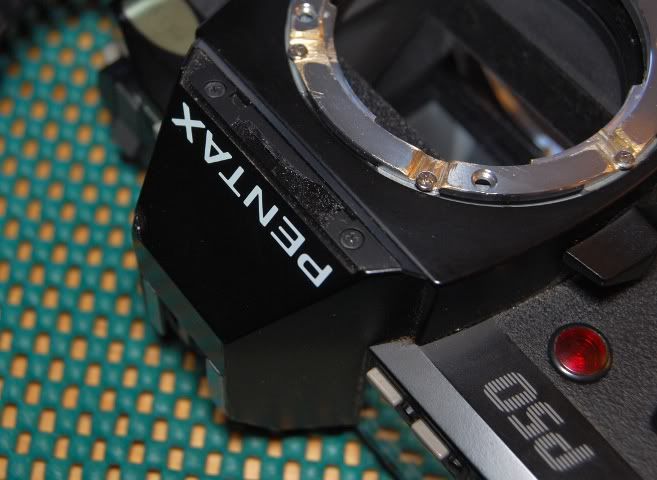
Speaking of Scheimpflug, I just gotta ask -- sorry don't mean to hijack the thread -- but I'm just real curious what was done to that Pentax's lens mount. It doesn't appear to be a Nikon flange . . . what is it?
_________________
Michael
My Gear List: http://michaelmcbroom.com/photo/gear.html
My Gallery: http://michaelmcbroom.com/gallery3/index.php/
My Flickr Page: https://www.flickr.com/photos/11308754@N08/albums
My Music: https://soundcloud.com/michaelmcbroom/albums
My Blog: http://michaelmcbroom.com/blogistan/ |
|
| Volver arriba |
|
|
Scheimpflug
Registrado: 06 Feb 2010
Mensajes: 1888
Ubicación: New Zealand / USA
Expire: 2011-11-18
|
Publicado: Sáb Mar 05, 2011 7:59 pm Asunto: |
|
Publicado: Sáb Mar 05, 2011 7:59 pm Asunto: |
|
|
Scheimpflug wrote:
| cooltouch escribió: |
| Speaking of Scheimpflug, I just gotta ask -- sorry don't mean to hijack the thread -- but I'm just real curious what was done to that Pentax's lens mount. It doesn't appear to be a Nikon flange . . . what is it? |
That actually is a Nikon flange. You can read about my P30/P50 Pentax to Nikon mount conversion here:
http://forum.mflenses.com/pentax-p30t-and-p50-nikon-f-body-mount-conversion-t29918.html
The mount I used is made of brass, with a chrome plating. Both are quite shiny, but in different ways, so when the light hits it right it really accents the parts which were filed and any little scratch in the chrome. In this photo I used a flash at a close distance, which makes it look much "rougher" than it actually is.
The front trim plate on the Pentax is removed as well, as the photo was illustrating a step from my P50 shutter button repair guide:
http://forum.mflenses.com/how-to-pentax-p50-shutter-button-repair-guide-t31702.html
_________________
Sigma DP1, Nikon D40 (hers ), Polaroid x530, Pentax P30t, Pentax P50, (P30t/P50 K-A to Nikon F body mount conversion)
Nikon: 18-55/3.5-5.6 "G ED II DX" (F) Soligor: 28/2.8 (FL->F converted), 135/3.5 (F), 3x TC (F, modified) Kalimar: 28-85/3.5 (F)
Vivitar: 70-210/2.8-4.0 Version 3 (F), Tele 500/6.3 Preset (F), 19/3.8 (F) Minolta: 300/5.6 (SR/MC/MD pending F conversion)
Tamron: 28/2.8 (Adaptall) Panagor: 28/2.5 (FD) Aetna: 300/5.6 (F) Osawa: MC 28/2.8 (F)
Vintage Lenses: Dallmeyer: 1940s A.M. 14in 356mm f4 (ULF->M42) 1930s Adon Telephoto Taylor, Taylor & Hobson: 1880s Rapid Rectilinear 8 1/2 x 6 1/2 11.31in f/8 (LF->?)
Parts Lenses: Nikon 35-135/3.5-4.5 (F), Sigma 70-210/4.5 (F), Nikon 50/1.8 Series E (F) |
|
| Volver arriba |
|
|
cooltouch
Registrado: 15 Ene 2009
Mensajes: 9096
Ubicación: Houston, Texas
|
Publicado: Sáb Mar 05, 2011 8:41 pm Asunto: |
|
Publicado: Sáb Mar 05, 2011 8:41 pm Asunto: |
|
|
cooltouch wrote:
Well, okay -- I was looking at one of my Nikons and the Nikon screw holes didn't seem to line up. But if I would have been paying attention  I would have noticed the Nikon meter coupling prong on the lens mounted to your Pentax! Oh well, mystery solved.
_________________
Michael
My Gear List: http://michaelmcbroom.com/photo/gear.html
My Gallery: http://michaelmcbroom.com/gallery3/index.php/
My Flickr Page: https://www.flickr.com/photos/11308754@N08/albums
My Music: https://soundcloud.com/michaelmcbroom/albums
My Blog: http://michaelmcbroom.com/blogistan/ |
|
| Volver arriba |
|
|
|
|
|
No puedes publicar temas nuevos en este foro
No puedes responder a temas en este foro
No puedes editar tus mensajes en este foro
No puedes borrar tus mensajes en este foro
No puedes votar en las encuestas de este foro
|
 Español
 中文
 Magyar
 Русский
 Deutsch
 日本語
 Français


