| Ver tema anterior :: Ver tema siguiente |
| Autor |
Mensaje |
Alsatian2017 

Registrado: 05 Mar 2018
Mensajes: 293
|
 Publicado: Dom Mar 29, 2026 9:40 am Asunto: |
|
Publicado: Dom Mar 29, 2026 9:40 am Asunto: |
|
|
Alsatian2017 wrote:
| Gerald escribió: |
Just a follow-up of my previous comments on how the prices of Carl Zeiss Jena lenses have held up well over time.
Compare, for example, what happened to certain lenses from well-known brands that were a sensation when new. A Vivitar Series 1 24-48mm F3.8 cost £336 in 1979 (source: Amateur Photography), a value that adjusted for inflation would be $2239 today. However, the actual market price for good condition copies is only $60-$100. |
Most samples of the 24-48 mm, Kino oblige, suffer today from sticky aperture blades and need repair. A lens buyer today can choose from different competitors which are as good or even better than the Kiron made 24-48 mm, for example Minolta MD 24-50 mm, Tamron SP 24-48 mm or Nikon Nikkor 25-50 mm.
| Gerald escribió: |
| In contrast, a Carl Zeiss Jena Pancolar 80mm F1.8 lens, which cost £89 when new in 1979, is sold secondhand on eBay for over $1000 today! |
The price you quoted is not of a sold item but of one advertised by one of those crazy professionnal sellers who try to drive prices skyhigh. Nobody with a brain would spend that much money for this certainly rare lens.
| Gerald escribió: |
| Another interesting example, at least for me, is the Minolta MD 400mm F5.6, which was a lens that promised exceptional performance due to the use of a fluorite element for virtual elimination of chromatic aberration. The price reflected the expected performance: £1138 in 1979, corresponding to $7543 today! Certainly, the original high price explains why this lens is relatively rare today. Nonetheless, on eBay one can buy the Minolta MD 400mm F5.6 for $300-$400, that is, less than 10% of the original adjusted price. This example also shows that scarcity is not necessarily a factor in making a used lens to be expensive. |
The Minolta MD 400 mm f/5.6 APO is an excellent lens but feedback from users is rare (I seem to be the only one having written a meaningful review of this lens).BTW, I've got mine for 200 Euro several years ago.
_________________
Personal website : https://volkergilbertphoto.com
Classic lenses : https://volkergilbertphoto.com/objektive/
Adobe Lens Correction profiles :
https://volkergilbertphoto.com/adobe-lens-profiles-for-classic-lenses/
Instagram : https://www.instagram.com/volker.gilbert/ |
|
| Volver arriba |
|
 |
hazedoesntfazeme

Registrado: 29 Ago 2025
Mensajes: 62
|
Publicado: Dom Mar 29, 2026 7:41 pm Asunto: |
|
Publicado: Dom Mar 29, 2026 7:41 pm Asunto: |
|
|
hazedoesntfazeme wrote:
Sorry for taking so long to reply. I keep forgetting to check back here.
| Gerald escribió: |
Obviously, Carl Zeiss Jena didn't have as extensive a lens line as Nikon, because CZJ wasn't targeting the global professional market. CZJ produced lenses only for cameras manufactured in East Germany. The estimated number of professional photographers in East Germany was between 5,000 and 10,000, a relatively small number that wouldn't justify the cost of developing lenses specifically for professional use.
As I said above, CZJ produced lenses only for East Germany cameras.
Nikon, Canon, etc., used proprietary lens mounts precisely to prevent or hinder other lens manufacturers from producing compatible lenses. Remember that CZJ was a state-owned company in a communist country, meaning it was on the "wrong side of the wall." The chance of CZJ producing lenses under license from Nikon was nil. |
Correct me if I'm wrong, soviet manufacturers made lenses for the nikon mount. What prevented CZJ of doing the same, specially in the 80's? Why there are Helios lenses for nikon mount for as far as I know, no CZJ lenses for it?
And my question regarding a possible professional line, I didn't explain myself properly.
I don't have a lot of knowledge about CZJ history, but it seems to me that by the 80's the market for SLR camera lenses was diminishing greatly, and they didn't have the know how for electronics and to produce a best seller compact camera (by they I mean also Pentacon and other companies they had absorbed by then).
Under this scenario doesn't it make sense to shift lens manufacturing to a market that has more added value, each lens costs more, the quality is higher, electronics matter less and the final product price is higher?
I imagine that the answer for this would be that indeed they were not able to re-calibrate to a different market under a socialist system and were constrained.
Yet they had the line of P6 lenses- which can be called professional in a sense- that seemed have hardly updated through the years. So what made the P6 lenses languish? |
|
| Volver arriba |
|
|
Gerald

Registrado: 25 Mar 2014
Mensajes: 1292
Ubicación: Brazil
|
Publicado: Lun Mar 30, 2026 1:52 pm Asunto: |
|
Publicado: Lun Mar 30, 2026 1:52 pm Asunto: |
|
|
Gerald wrote:
| Noritar escribió: |
I have always wanted the Pancolor 80. But in a world where the Pancolor sells for the same price as the Topcor... I buy the Topcor. |
I also don't own any of those lenses, and I'm not going to recommend, for or against, anyone spending $500 to $1000 on a 50-year-old 85mm F1.8 lens, because that person certainly knows what he/she is doing and doesn't need advice.
Buying a used lens is always a considerably risky operation. Obviously, the lens no longer has the manufacturer's warranty. Furthermore, the lens may have dirty or compromised optical surfaces, the focusing system may be worn or the lubricant aged, the diaphragm system may be stuck, the lens may have been tampered with by someone incompetent, etc.
Unfortunately, most people who buy a used lens don't know how to properly test a lens, let alone know if the lens is in its original specification.
A professional photographer who makes a living from photography probably wouldn't buy a used portrait lens for $1000. He would buy a brand new 85mm F1.8 lens, with all the automatic features, from Sony, Nikon, Canon or Panasonic, which cost between US$600 and US$750.
_________________
If raindrops were perfect lenses, the rainbow did not exist. |
|
| Volver arriba |
|
|
Gerald
Registrado: 25 Mar 2014
Mensajes: 1292
Ubicación: Brazil
|
Publicado: Mar Mar 31, 2026 12:24 pm Asunto: |
|
Publicado: Mar Mar 31, 2026 12:24 pm Asunto: |
|
|
Gerald wrote:
| Alsatian2017 escribió: |
The Minolta MD 400 mm f/5.6 APO is an excellent lens but feedback from users is rare (I seem to be the only one having written a meaningful review of this lens).BTW, I've got mine for 200 Euro several years ago. |
I read your review (with some difficulty because it was written in German) about the Minolta MD 400mm F5.6 APO. Very informative, I enjoyed it a lot!
Perhaps you should consider translating all reviews into English, which would certainly expand the site's audience considerably.
_________________
If raindrops were perfect lenses, the rainbow did not exist. |
|
| Volver arriba |
|
|
Gerald
Registrado: 25 Mar 2014
Mensajes: 1292
Ubicación: Brazil
|
Publicado: Mié Abr 01, 2026 1:26 pm Asunto: |
|
Publicado: Mié Abr 01, 2026 1:26 pm Asunto: |
|
|
Gerald wrote:
| hazedoesntfazeme escribió: |
Correct me if I'm wrong, soviet manufacturers made lenses for the nikon mount. What prevented CZJ of doing the same, specially in the 80's? Why there are Helios lenses for nikon mount for as far as I know, no CZJ lenses for it?
|
There were technical, economic, political, and legal reasons for this, but suffice it to say that Zeiss Oberkochen only started making lenses with Nikon mounts in 2006, that is, 15 years after the fall of the Berlin Wall and consequent end of Carl Zeiss Jena!
If Zeiss Oberkochen, which was a capitalist company fully integrated into the Western market, did not make lenses with Nikon mounts before 2006, why would you expect Carl Zeiss Jena, which was a state-owned company in a communist country, to do so in the 1980s and before?
| hazedoesntfazeme escribió: |
Yet they (CZJ) had the line of P6 lenses- which can be called professional in a sense- that seemed have hardly updated through the years. So what made the P6 lenses languish? |
I'm not sure if I understood what you meant when you said "what made the P6 lenses languish"...
Back in the 1960s, Carl Zeiss Jena had already built a comprehensive line of lenses for the Pentacon Six, with focal lengths ranging from 50 to 1000mm. In other words, "all bases had been covered", except perhaps for the lack of an ultra-wideangle lens. Nevertheless, Schneider offered the excellent Curtangon 40mm F4.0 for the Pentacon Six. There was also the Arsenal Mir-26 45mm F3.5, so Carl Zeiss Jena didn't need to expend precious resources designing and producing a lens that would be of relatively little use by Pentacon Six users.
For those who don't know, this website has a treasure trove of information about the Pentacon Six, its lenses and accessories:
https://pentaconsix.com/
_________________
If raindrops were perfect lenses, the rainbow did not exist. |
|
| Volver arriba |
|
|
LittleAlex

Registrado: 27 Nov 2008
Mensajes: 2085
Ubicación: L'vov (Western Ukraine)
|
Publicado: Mié Abr 01, 2026 2:43 pm Asunto: |
|
Publicado: Mié Abr 01, 2026 2:43 pm Asunto: |
|
|
LittleAlex wrote:
| hazedoesntfazeme escribió: |
soviet manufacturers made lenses for the nikon mount. What prevented CZJ of doing the same, specially in the 80's? Why there are Helios lenses for nikon mount for as far as I know, no CZJ lenses for it?
|
The reason is quite evident. In the USSR they produced SLR camera with the Nikon F mount. But in the DDR there had not been any such camera line.
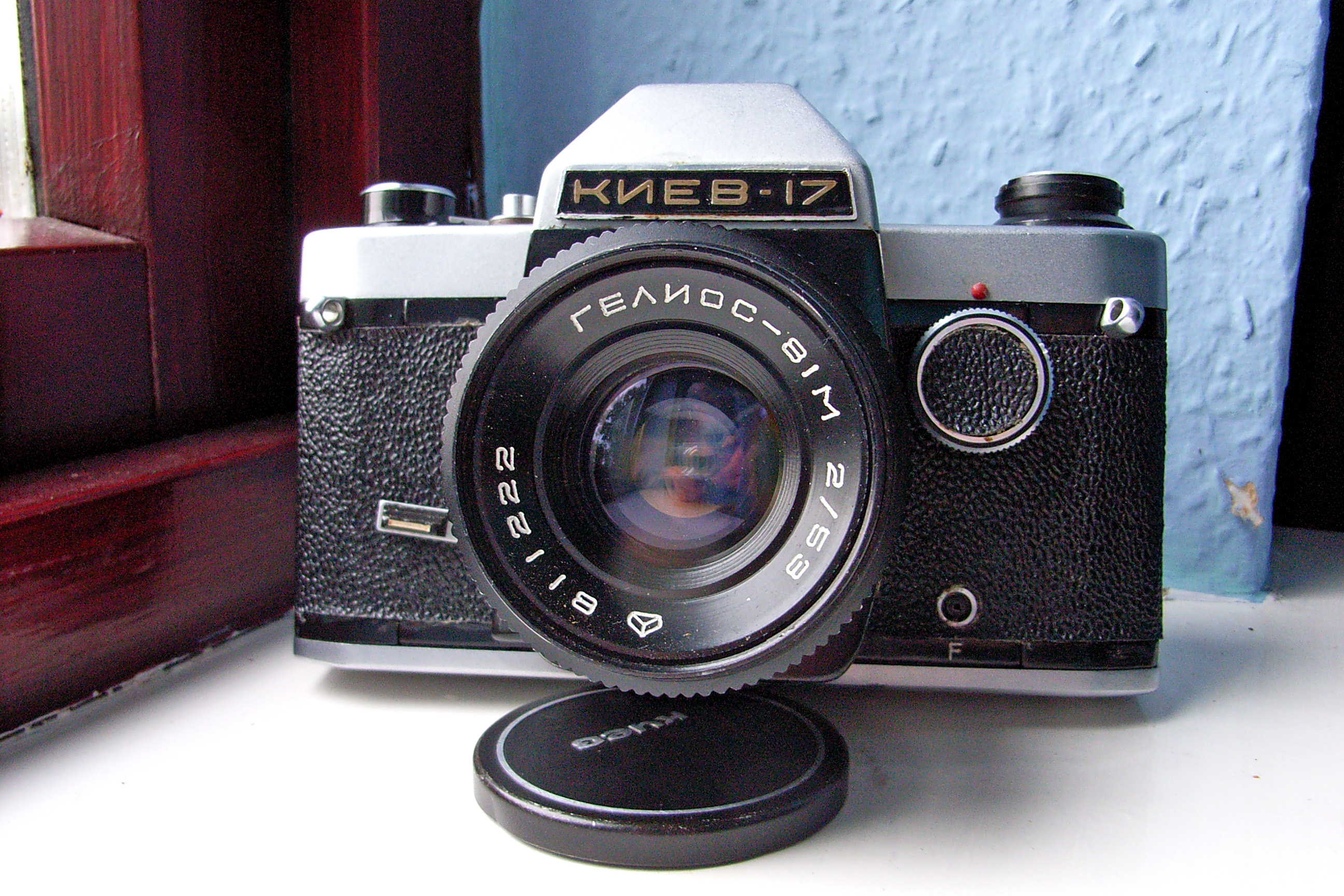
In the early 1970s, the Soviet Union’s central planners knew that they were falling behind in the development SLRs – a segment of cameras that was widely seen as the pinnacle of camera technology. Hence, and in preparation for the 1980 Moscow Olympics (and the flocks of foreign photographers coming to visit the workers’ paradise), a new line3 of high-end cameras was commissioned4. The first camera of this new line was the Kiev-17 and it was introduced in 1977.
Compared to existing Soviet SLRs, the new Kiev-17 offered some interesting additions: Firstly, it contained a metal blade vertical-travel focal plane shutter. This was in stark contrast to the focal plane shutters of all other Soviet фотоаппарат’s to date, which either used cloth shutters or the fan-blade contraption in the Kiev-10/15. Second, the Kiev-17’s shutter offered a full range of shutter speeds from 1/1000 second to 1 second (+ Bulb) – also not usual.
The second interesting addition was that this new camera neither used a pre-war thread mount (like M42, LTM or Z39) or a mount appropriated as ‘reparations’5 (such as the Contax/Kiev mount), but instead settled on using the Nikon F mount – a mount that was (at that time) still at its peak.
https://japb.net/business/a-soviet-nikon/
_________________
"Sharpness is a bourgeois concept" - © H. Cartier Bresson |
|
| Volver arriba |
|
|
stevemark

Registrado: 29 Abr 2011
Mensajes: 5511
Ubicación: Switzerland
|
Publicado: Mié Abr 01, 2026 7:22 pm Asunto: |
|
Publicado: Mié Abr 01, 2026 7:22 pm Asunto: |
|
|
stevemark wrote:
| Alsatian2017 escribió: |
| Gerald escribió: |
| In contrast, a Carl Zeiss Jena Pancolar 80mm F1.8 lens, which cost £89 when new in 1979, is sold secondhand on eBay for over $1000 today! |
The price you quoted is not of a sold item but of one advertised by one of those crazy professionnal sellers who try to drive prices skyhigh. Nobody with a brain would spend that much money for this certainly rare lens.
|
There's one available, like new, locally, for 450.--. Should I get it ...    ??
S
_________________
www.artaphot.ch |
|
| Volver arriba |
|
|
Gerald
Registrado: 25 Mar 2014
Mensajes: 1292
Ubicación: Brazil
|
Publicado: Jue Abr 02, 2026 6:31 pm Asunto: |
|
Publicado: Jue Abr 02, 2026 6:31 pm Asunto: |
|
|
Gerald wrote:
| stevemark escribió: |
There's one available, like new, locally, for 450.--. Should I get it ... ??
S |
If you ever had to ask whether you should buy a CZJ Pancolar 80mm F1.8, like new, for $450, then you don't need this lens!
There are many good alternatives to the Pancolar 80mm f1.8, such as your Canon FD 100mm f2 
_________________
If raindrops were perfect lenses, the rainbow did not exist. |
|
| Volver arriba |
|
|
Alsatian2017
Registrado: 05 Mar 2018
Mensajes: 293
|
Publicado: Jue Abr 02, 2026 7:31 pm Asunto: |
|
Publicado: Jue Abr 02, 2026 7:31 pm Asunto: |
|
|
Alsatian2017 wrote:
| Gerald escribió: |
| Alsatian2017 escribió: |
The Minolta MD 400 mm f/5.6 APO is an excellent lens but feedback from users is rare (I seem to be the only one having written a meaningful review of this lens).BTW, I've got mine for 200 Euro several years ago. |
I read your review (with some difficulty because it was written in German) about the Minolta MD 400mm F5.6 APO. Very informative, I enjoyed it a lot!
Perhaps you should consider translating all reviews into English, which would certainly expand the site's audience considerably. |
Thanks, I'm definitely thinking about translating the articles, it will just take some time.
_________________
Personal website : https://volkergilbertphoto.com
Classic lenses : https://volkergilbertphoto.com/objektive/
Adobe Lens Correction profiles :
https://volkergilbertphoto.com/adobe-lens-profiles-for-classic-lenses/
Instagram : https://www.instagram.com/volker.gilbert/ |
|
| Volver arriba |
|
|
Alsatian2017
Registrado: 05 Mar 2018
Mensajes: 293
|
Publicado: Jue Abr 02, 2026 7:36 pm Asunto: |
|
Publicado: Jue Abr 02, 2026 7:36 pm Asunto: |
|
|
Alsatian2017 wrote:
| stevemark escribió: |
| Alsatian2017 escribió: |
| Gerald escribió: |
| In contrast, a Carl Zeiss Jena Pancolar 80mm F1.8 lens, which cost £89 when new in 1979, is sold secondhand on eBay for over $1000 today! |
The price you quoted is not of a sold item but of one advertised by one of those crazy professionnal sellers who try to drive prices skyhigh. Nobody with a brain would spend that much money for this certainly rare lens.
|
There's one available, like new, locally, for 450.--. Should I get it ... ?
S |
Well, I wouldn't pay three times the price of a very good Japanese lens to get it. Even though the Pancolar 80 mm f/1.8 has a sterling reputation ( it was considered to be one of the best lenses in this focal range back then), it shares the flims construction of other CZJ lenses of it's time.
_________________
Personal website : https://volkergilbertphoto.com
Classic lenses : https://volkergilbertphoto.com/objektive/
Adobe Lens Correction profiles :
https://volkergilbertphoto.com/adobe-lens-profiles-for-classic-lenses/
Instagram : https://www.instagram.com/volker.gilbert/ |
|
| Volver arriba |
|
|
stevemark
Registrado: 29 Abr 2011
Mensajes: 5511
Ubicación: Switzerland
|
Publicado: Jue Abr 02, 2026 8:35 pm Asunto: |
|
Publicado: Jue Abr 02, 2026 8:35 pm Asunto: |
|
|
stevemark wrote:
[quote="Gerald]
If you ever had to ask whether you should buy a CZJ Pancolar 80mm F1.8, like new, for $450, then you don't need this lens!
There are many good alternatives to the Pancolar 80mm f1.8, such as your Canon FD 100mm f2[/quote]
| Alsatian2017 escribió: |
Well, I wouldn't pay three times the price of a very good Japanese lens to get it. Even though the Pancolar 80 mm f/1.8 has a sterling reputation ( it was considered to be one of the best lenses in this focal range back then), it shares the flims construction of other CZJ lenses of it's time. |
I was just joking of course. You may have noticed that I rarely pay a lot of money for the lenses I'm testing and presenting here.
The last few lenses i bought were CHF 15.-- (Vivitar Series I 4/24-48mm), CHF 1.-- (Novoflex 4/105mm), CHF 5.-- (Olympus 3.5/50mm Macro), CHF 11.-- (Nikkor AiS 3.5-4.5/35-200mm), CHF 8.-- (Agfa Color Magnolar 4.5/105mm) and - as an exception - CHF 150.-- for a Leica Elmarit R 2.8/180mm ...
There's so much material avalaible locally for next to nothing ...
S
_________________
www.artaphot.ch |
|
| Volver arriba |
|
|
LittleAlex
Registrado: 27 Nov 2008
Mensajes: 2085
Ubicación: L'vov (Western Ukraine)
|
Publicado: Jue Abr 02, 2026 8:41 pm Asunto: |
|
Publicado: Jue Abr 02, 2026 8:41 pm Asunto: |
|
|
LittleAlex wrote:
| Gerald escribió: |
There are many good alternatives to the Pancolar 80mm f1.8, |
As, for example TTArtisan 75mm f/2
https://forum.mflenses.com/ttartisan-75mm-f-2-and-sony-a7s-t85956.html
And much, much cheaper of course

_________________
"Sharpness is a bourgeois concept" - © H. Cartier Bresson |
|
| Volver arriba |
|
|
|
|
|
No puedes publicar temas nuevos en este foro
No puedes responder a temas en este foro
No puedes editar tus mensajes en este foro
No puedes borrar tus mensajes en este foro
No puedes votar en las encuestas de este foro
|
 Español
 中文
 Magyar
 Русский
 Deutsch
 日本語
 Français



